
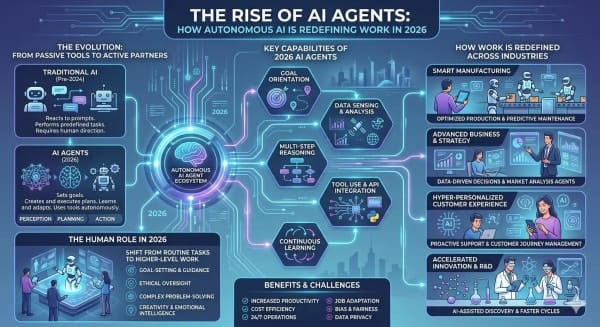
The Rise of AI Agents: How Autonomous AI Is Redefining Work in 2026
There is a moment in every technological revolution when the shift stops feeling like hype and starts feeling like gravity. For artificial intelligence, that moment is 2026 — and the catalyst is not a smarter chatbot. It is the AI agent: software that does not just answer questions, but sets goals, plans steps, calls tools, and executes tasks end-to-end, with minimal human involvement.
What Is an AI Agent, Exactly?
A traditional AI system responds. An agent acts. Given a goal — "reduce customer churn by 10% this quarter" — an agent will pull CRM data, identify at-risk segments, draft personalised outreach emails, schedule send times, monitor open rates, and iterate. All without a human clicking a single button between steps.
The enabling technology is a tight loop: a large language model for reasoning, tool-calling APIs for action, memory for context, and an orchestration layer that coordinates it all. When multiple agents collaborate — one researching, one writing, one fact-checking — you get a multi-agent system that can outperform entire human teams on specific, well-defined workflows.
The Numbers Are Not Subtle
The scale of adoption in 2026 is difficult to overstate. Gartner now projects that 40% of enterprise applications will embed task-specific AI agents by the end of this year, up from less than 5% in 2025. IDC expects AI copilots to be present in nearly 80% of workplace software. The agentic AI market — valued at $7.8 billion entering the year — is on a trajectory toward $52 billion by 2030, driven by a compound annual growth rate above 46%.
These are not speculative projections. They reflect contracts already signed, deployments already running, and productivity gains already measured. Companies using AI-powered personalisation agents report 5–8% revenue growth as a direct result. Enterprises running autonomous support agents report resolution times cut by more than half.
Industries Being Transformed Right Now
Finance: Algorithmic trading has existed for decades, but 2026 agents operate at a different level. They monitor regulatory filings, earnings calls, geopolitical signals, and satellite imagery simultaneously — synthesising signals no human analyst could process in real time — and execute or recommend trades within milliseconds of a material event.
Healthcare: Diagnostic agents now cross-reference patient records, genomic data, recent clinical trials, and live imaging to surface differential diagnoses that senior physicians then review and confirm. The agent does not replace the doctor; it eliminates the three hours of chart review that preceded the diagnosis.
Logistics: A telecommunications company in Germany recently deployed an agent that detects network anomalies, opens a field-service ticket, reroutes affected traffic, and notifies customers — before a human engineer is even paged. The entire cycle takes under 90 seconds.
Software development: Coding agents now handle entire feature branches: reading a product-requirements document, writing code, generating tests, fixing failures, and opening a pull request. Junior developers who once spent days on boilerplate are being redirected toward architecture decisions and edge-case review.
The Jobs Question: Honest Answers
The employment picture is more nuanced than either "AI takes all jobs" or "AI creates more jobs than it destroys." The honest answer in 2026 is: both are happening simultaneously, but not symmetrically.
Roles most exposed to displacement are those built around information retrieval, format conversion, first-pass drafting, and rule-based decision-making: data entry clerks, junior paralegals, basic customer-service agents, and entry-level code reviewers. These roles are not disappearing overnight — but headcount growth has flatlined, and attrition is no longer being backfilled.
Meanwhile, new categories are expanding fast. Agent-ops engineers monitor and retrain deployed agents. AI auditors test systems for bias, hallucination, and security vulnerabilities. Prompt architects design the instruction frameworks that govern agent behaviour at scale. Human-AI workflow designers re-engineer business processes to exploit agent capabilities without losing the human judgment that still matters in high-stakes decisions.
The critical variable is not whether AI agents eliminate jobs in aggregate. It is whether the new jobs are accessible to the people whose old jobs disappear — and that is a policy question, not a technology question.
Governance: The Race Nobody Is Winning
The governance gap is perhaps the most important story of 2026. Agents are being deployed faster than organisations — or governments — can build oversight frameworks for them.
The EU AI Act entered full enforcement this year, requiring high-risk AI systems in healthcare, finance, and critical infrastructure to maintain human oversight checkpoints, audit trails, and explainability documentation. Compliance teams are overwhelmed. The United States has issued executive guidance mandating "human in the loop" controls for federal AI deployments, but enforcement mechanisms remain weak. China has accelerated state-directed agent deployment across manufacturing and surveillance with far fewer restrictions.
Inside enterprises, a paradox has emerged: most Chief Information Security Officers report serious concern about agent risks, yet fewer than a third have implemented mature safeguards. Agents make runtime decisions, access sensitive data, and take consequential actions — none of which traditional software security models were designed to govern. The organisations that solve this problem first will have a durable competitive advantage. The ones that do not will eventually face a very public failure.
What You Should Actually Do About This
If you lead an organisation: the question is no longer "should we evaluate AI agents?" It is "how fast can we build the governance infrastructure that makes agents safe to deploy at scale?" The bottleneck has shifted from capability to accountability.
If you are an individual professional: the durable skill is not any particular tool — tools change every six months. It is the ability to decompose complex goals into supervised workflows, evaluate agent output critically, and understand where human judgment is irreplaceable. The workers thriving in 2026 are not the ones who use AI least. They are the ones who know precisely when not to trust it.
The agentic era is not a future scenario. It is the operating environment. The only remaining question is how deliberately you choose to navigate it.