
Dublin Summits: Europe Names Its Team for Ukraine Talks as EU Weighs €500 Billion AI Push
Europe's leaders spent the second week of November in Dublin, where two back-to-back summits meant to spotlight artificial intelligence and regional cooperation were instead overshadowed by the diplomatic race to end the war in Ukraine. With a special European Council due on 26–27 November, the coming weeks will decide how the EU funds Kyiv, sanctions Moscow and prepares its own enlargement.
Europe Claims a Seat in Ukraine Peace Diplomacy
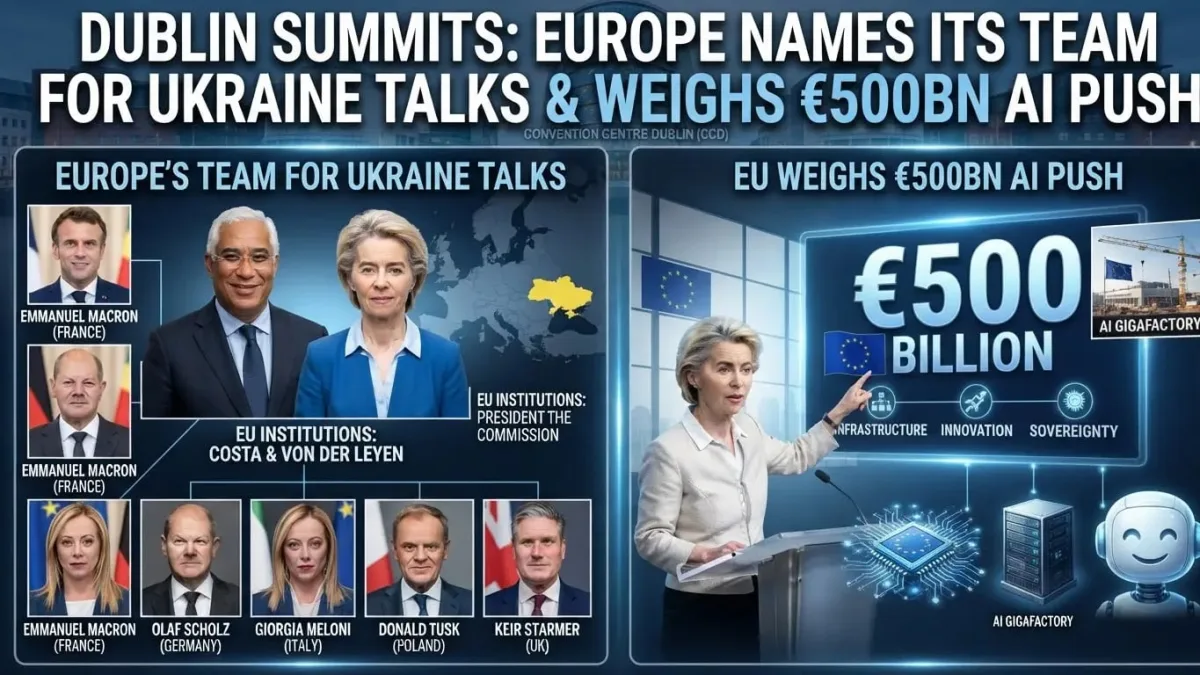
On 12 November, the ninth European Political Community summit brought leaders from across the continent to Dublin, where 43 countries signed a declaration stating that European security must be decided by Europeans and reaffirming the need for robust, credible security guarantees for Ukraine. The next day, after the informal European Council, Council President António Costa and Commission President Ursula von der Leyen announced a “European team” made up of the Council, the Commission and five European countries known as the E5, to represent the continent as multilateral talks with the US, Ukraine and Russia begin. The push followed trilateral talks in Abu Dhabi between Russia, the United States and Ukraine, which reportedly produced an agreement on a large-scale prisoner exchange. President Volodymyr Zelenskyy said Europe would sit in the negotiating team at the next meeting, although the Kremlin had earlier played down that prospect.
AI Takes the Stage, but Funding Questions Remain
The informal summit was the first time EU leaders devoted a meeting solely to artificial intelligence, hearing from Mistral CEO Arthur Mensch and Nobel laureate Geoffrey Hinton. The Commission estimates that tech sovereignty will require at least €500 billion in investment in chips, computing power and frontier AI, and von der Leyen pointed to the Savings and Investment Union, private capital and the next long-term EU budget as possible sources. Around €30 billion is being mobilised for seven planned AI gigafactories, with up to €10 billion coming from public funds, and leaders agreed to return to the topic in early 2027.
Sanctions and Ukraine's 2027 Financing Come to a Head
Von der Leyen confirmed that the Commission will present a 22nd sanctions package against Russia and an options paper on covering Ukraine's 2027 financial needs before the special European Council on 26–27 November. The aim is to adopt the sanctions by the end of the year, although some capitals question whether new measures send the right signal while peace talks are under way. The proposal builds on the €90 billion support loan for 2026–2027 approved in April, whose second half, €45 billion for 2027, the Commission proposed to pay out on 30 October. The EU is also preparing winter assistance for Ukraine, including 500 generators from its rescEU reserves.
Enlargement Roadmaps Put Montenegro on Track for 2028
On 4 November, the Commission presented its 2026 Enlargement Package, offering for the first time indicative roadmaps for Montenegro, Albania, Moldova and Ukraine. Montenegro has provisionally closed 21 chapters and could close the remaining ones by the end of 2026 if member states agree, keeping it on course to become the EU's 28th member in 2028. The target dates for concluding negotiations are 2027 for Albania, early 2028 for Moldova and the end of 2028 for Ukraine. Serbia, Georgia and Türkiye drew sharp criticism, and Serbia's level of preparation was downgraded in education and culture as well as in freedom of expression.
Also on the European Radar
Hungary, under Prime Minister Péter Magyar, is set to receive almost €10 billion in recovery funds that were frozen under Viktor Orbán, with Commission approval expected this month. Spain, meanwhile, held its first general strike in 14 years ahead of a snap general election on 29 November.