

The Tripartite AI Schism: Europe’s Regulatory Bazooka, America’s Strategic Capture, and China’s Local compute Triumph
The Battlefront Shifts to Computing Power and Trust
The global race for Artificial Intelligence supremacy has entered a new, multi-front phase as of June 2027. While the technological cold war between the United States and China has continued, it has mutated. We are no longer witnessing a binary struggle, but rather a tripartite schism that fundamentally redraws the digital map. Decoupling is the new default state of international technology.
This month, a series of rapid-fire developments has brought the conflict to a physical and infrastructural head, leaving the original concept of an interconnected digital economy as a memory of the early 21st century.
USA: Strategic Capture and the Compute Squeeze
Washington has formally implemented a doctrine of 'strategic capture.' Leveraging its control over advanced semiconductor design and cloud computing, the US administration has declared private US AI firms as 'strategic assets essential to national security.' Forcing companies like OpenAI, Microsoft, and Alphabet into closer alignment with US defense priorities, this directive ensures that the frontiers of foundational models are effectively under Washington’s thumb.
A critical component of this capture is a complete and absolute ban on Chinese access to American cloud computing infrastructure for training foundational models. US cloud providers are now legally obligated to use 'compute fingerprinting' to detect and terminate any such training attempts, effectively building a digital 'Silicon Curtain' that physically segregates the processing power.
A State Department official, speaking at a generic briefing, summarized, "We are ensuring that raw compute power remains a Western strategic monopoly. No hostile power will be able to leverage our own digital infrastructure to surpass us."
China: Squeezing the Critical Minerals Supply and Local Compute Triumph
Beijing’s retaliation has been twofold and equally severe. Squeezing the raw material side of the digital economy, China’s Ministry of Commerce announced a generalized restriction on the export of all derived high-grade rare-earth oxides, refined lithium, and, in a critical escalation, advanced gallium arsenide wafers, which are essential for high-performance optics and sensors in next-generation AI systems.
Simultaneously, China has achieved a landmark triumph: the successful pre-training of a trillion-parameter LLM, DeepSeek-V3, using purely domestic logic-chip clusters. By optimizing software for local architectures, Chinese engineers have bypassed US compute constraints, moving toward true technological self-reliance. This development signals that China\'s adapted strategy of model distillation and efficient software is bearing fruit, allowing them to compete without access to the absolute cutting edge of US silicon.
A spokesperson for Beijing\'s Ministry of Industry stated, "The West cannot contain our progress. We are defining our own path to innovation, built on our resources, our engineers, and our own digital infrastructure."
Europe: Regulatory Bazooka and Sovereign Clouds
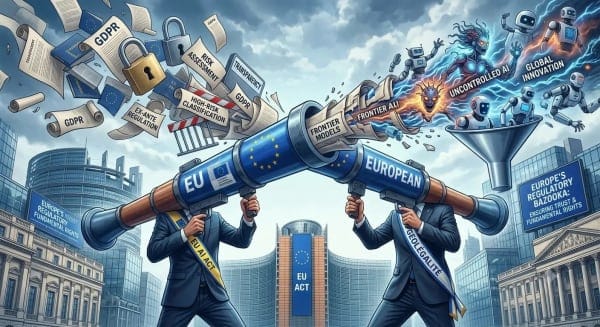
The European Union, caught between the two superpowers, has chosen the path of a unique regulatory and sovereign defense. The landmark EU AI Act is now fully implemented and carrying a 'regulatory bazooka' effect. This month, major US tech companies were hit with multiple fines, totaling €17.5 billion, for deploying 'untrustworthy' systems without adequate European legal and ethical audits.
This aggressive regulatory stance is a direct part of a tripartite strategy. Brussels is using its market size to enforce high legal standards, but it\'s also using that enforcement to fund its own 'strategic autonomy.' Simultaneously, the EU has launched the first five localized 'AI Factories' and multiple sovereign AI clouds, with the official goal of having European governments and public administrations use localized, 'Trustworthy AI' models that are completely severed from foreign digital infrastructure by 2030.
An EU Commissioner for the Internal Market concluded, "Europe will not be a vassal state. Our power is our law. We are building a digital sphere where innovation is balanced with human rights, and we are creating the sovereign clouds to make that a reality."
Conclusion: Walled Gardens and Supply Chain Shocks
The world faces the reality of three incompatible AI ecosystems. Isolated research pools and distinct, walled standards are the new global default. Friend-shoring and reshoring of tech manufacturing are increasing consumer prices worldwide. For emerging economies, the pressure is building to choose a digital alliance. Europe's choices have determined that it is not merely aregulated marketplace, but rather an active, sovereign player that will define its own digital future between the two competing superpowers.