

Click to enlarge
Montenegro Pushes for 2028 EU Membership Amidst Regional Hurdles
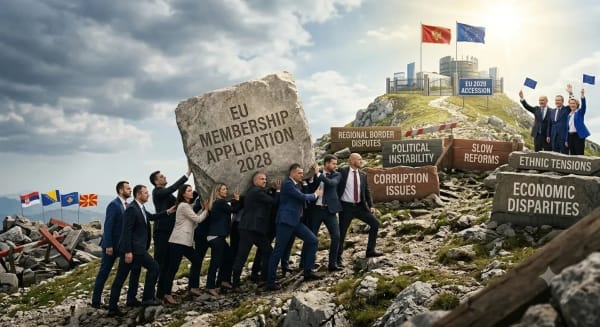
Montenegro is accelerating its path toward European Union membership, officially targeting to become the bloc's next member state by 2028. As the absolute frontrunner in the EU enlargement process among Western Balkan nations, Montenegro has made significant strides in recent months, though regional disputes highlight the complex road ahead.\r
Closing Crucial Chapters
During the 28th Accession Conference held in Brussels on July 14, 2026, Montenegro successfully provisionally closed two more negotiating chapters: Chapter 8 (Competition Policy) and Chapter 29 (Customs Union). This milestone brings the total number of provisionally closed chapters to 18 out of the 33 required for EU accession, officially pushing the country past the halfway mark.
The government in Podgorica has set a highly ambitious internal deadline to close all remaining negotiating chapters by the end of 2026. This timeline is heavily supported by the European Commission, which increasingly views Montenegro’s successful accession as a vital geopolitical necessity for European stability and a catalyst for other candidate countries like Moldova, Ukraine, and Serbia.
Croatia's Stumbling Block
Despite the historic momentum, Montenegro's European integration is facing unexpected friction from a neighboring EU member state. In late July 2026, Croatia moved to block the provisional closure of Chapter 31, which covers Foreign, Security, and Defence Policy. Zagreb has presented Podgorica with a list of demands regarding unresolved bilateral issues, reminding Montenegro that good-neighborly relations remain a fundamental political criterion for EU membership.
This development has sparked concerns in Brussels that the 2028 accession target could be delayed if diplomatic solutions are not reached swiftly. Bilateral disputes have historically served as significant bottlenecks for Western Balkan integration.
The Road Ahead
As 2026 progresses, the European Union is already preparing the legal framework for Montenegro's eventual integration. An Ad Hoc Working Party is reportedly drafting the legal fine print of the accession treaty, heavily modeled on Croatia's 2013 entry framework. The next few months will be critical for Montenegro as it attempts to balance sweeping domestic judicial reforms with delicate regional diplomacy.
Closing Crucial Chapters
During the 28th Accession Conference held in Brussels on July 14, 2026, Montenegro successfully provisionally closed two more negotiating chapters: Chapter 8 (Competition Policy) and Chapter 29 (Customs Union). This milestone brings the total number of provisionally closed chapters to 18 out of the 33 required for EU accession, officially pushing the country past the halfway mark.
The government in Podgorica has set a highly ambitious internal deadline to close all remaining negotiating chapters by the end of 2026. This timeline is heavily supported by the European Commission, which increasingly views Montenegro’s successful accession as a vital geopolitical necessity for European stability and a catalyst for other candidate countries like Moldova, Ukraine, and Serbia.
Croatia's Stumbling Block
Despite the historic momentum, Montenegro's European integration is facing unexpected friction from a neighboring EU member state. In late July 2026, Croatia moved to block the provisional closure of Chapter 31, which covers Foreign, Security, and Defence Policy. Zagreb has presented Podgorica with a list of demands regarding unresolved bilateral issues, reminding Montenegro that good-neighborly relations remain a fundamental political criterion for EU membership.
This development has sparked concerns in Brussels that the 2028 accession target could be delayed if diplomatic solutions are not reached swiftly. Bilateral disputes have historically served as significant bottlenecks for Western Balkan integration.
The Road Ahead
As 2026 progresses, the European Union is already preparing the legal framework for Montenegro's eventual integration. An Ad Hoc Working Party is reportedly drafting the legal fine print of the accession treaty, heavily modeled on Croatia's 2013 entry framework. The next few months will be critical for Montenegro as it attempts to balance sweeping domestic judicial reforms with delicate regional diplomacy.