

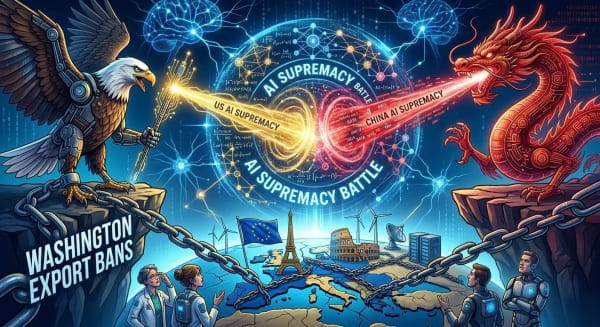
US–China AI Supremacy Battle: New Washington Export Bans Shackle Europe's Tech Sector
The Escalating Struggle for Artificial General Intelligence Dominance
The technological cold war between the United States and China has reached a fever pitch in May 2026. Washington has officially implemented a comprehensive new suite of export controls targeting not just advanced semiconductors, but the very algorithms and cloud computing infrastructure essential for developing Artificial General Intelligence (AGI).
This move, framed by the US administration as vital for national security, aims to legally and physically prevent China from acquiring the computational power necessary to surpass Western AI capabilities. However, the immediate ripple effects are causing an economic tremor across the Atlantic, leaving the European Union caught in the geopolitical crossfire.
Washington’s 'Silicon Curtain' Descends
The new Department of Commerce regulations constitute the most severe tech embargo of the digital age. They ban US cloud providers (like Amazon Web Services and Microsoft Azure) from allowing Chinese entities to train large language models on their servers. Furthermore, the sale of specialized AI hyperexciters—the 2026 successor to the H100 chips—is now totally prohibited to any entity with Chinese state capitalization.
US Secretary of State, speaking at a generic briefing, emphasized, "We must ensure that the frontiers of AGI are defined by democratic values, not authoritarian control. This is not just an economic issue; it is a long-term security imperative."
Europe in the Crossfire: Economic Realities vs. Strategic Alliances
For Europe, the US mandate presents a nearing impossible dilemma. European tech giants and research institutions rely heavily on both US foundational models and Chinese hardware components.
The new regulations apply "extra-territorial" jurisdiction, meaning European companies using American technology—which applies to almost all of them—must comply with the US ban or face severe sanctions, including being cut off from the US financial system.
In Berlin and Paris, leaders are expressing growing frustration. While Europe shares US concerns regarding China's aggressive surveillance state, the economic cost of decoupling is staggering. China remains Europe's largest trade partner for electronics, and several EU AI startups are funded by Chinese venture capital.
The Push for European 'Strategic Autonomy'
The crisis has re-energized the debate over European "strategic autonomy." EU Commissioner for Internal Market argued, "Europe cannot accept being a vassal state to either the US or China in the digital age. We must accelerate our own sovereign AI clouds and semiconductor manufacturing."
However, analysts warn that building a completely independent European tech stack would take at least a decade and trillions of Euros in investment, a luxury Europe may not have as the AGI race accelerates.
China Retaliates: The Battle for Critical Minerals
Beijing has not remained passive. Within hours of the US announcement, China’s Ministry of Commerce hinted at reciprocal measures, specifically targeting the export of Gallium, Germanium, and refined Lithium—critical minerals required for the very semiconductor manufacturing the US is trying to encourage on home soil.
A Chinese Ministry spokesperson stated, "The US is weaponizing global supply chains under the guise of national security. China will take all necessary measures to defend its technological development rights."
What Happens Next for the Global Economy?
The world now faces the reality of a bi-polar digital ecosystem.
If this tech schism persists, the global economy could see:
- **Fragmented AI Standards:** Two distinct, incompatible AI ecosystems (US-aligned vs. China-aligned), creating massive friction for international business.
- **Increased Inflation:** The cost of friend-shoring and reshoring tech manufacturing will likely increase consumer electronics prices globally.
- **Deceleration of Innovation:** Isolated research pools could slow the overall progress of global AGI development.
As the US and China brace for a prolonged standoff, Europe’s choices in the coming months will determine if it remains a global digital player or merely a regulated marketplace between two tech superpowers.