
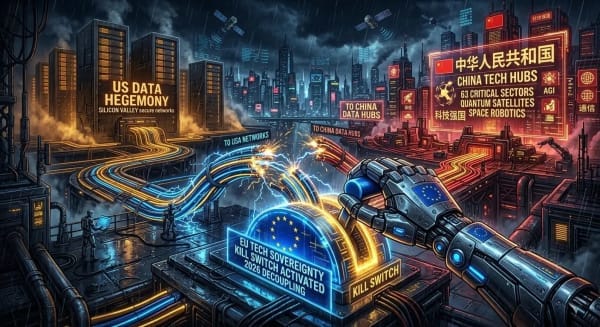
The Great Tech Decoupling: EU Deploys 'Kill Switch' Defenses as China Readies Counter-Sanctions
A Global Paradigm Shift: From Defense to Offense
The geopolitical landscape of artificial intelligence and critical technologies has fractured entirely as of June 2026. Moving beyond mere competition, the world's tech superpowers have initiated aggressive strategies focused on strategic control and retaliation. Following recent revelations that the US Commerce Department failed to effectively enforce its AI export controls, allowing Chinese military subsidiaries access to high-end American chips, the dynamic has fundamentally shifted. China is no longer just absorbing restrictions; it is actively preparing a counter-offensive.
China’s 63-Sector Retaliation List
In a dramatic reversal of the traditional trade war narrative, Beijing is shifting from a defensive posture to an offensive one. A groundbreaking study published by the Chinese Academy of Sciences has identified 63 critical technology sectors where China holds a global advantage and may soon restrict exports.
These proposed sanctions target the US and its allies, covering cutting-edge domains such as satellite quantum encrypted communications, space robotics, and miniaturized AI edge computing systems. By leveraging its massive open-source AI ecosystem, which currently leads globally in adoption and derivation, China is ensuring that the physical loop of AI deployment—such as embodied AI in advanced manufacturing—remains insulated from Western hardware blockades.
The EU's 'Kill Switch' and Tech Sovereignty Agenda
Caught in the crossfire, the European Union is executing its most aggressive protectionist moves to date. On June 3, the European Commission unveiled its "Tech Sovereignty" agenda, aiming to drastically cut its reliance on the US and China. A key component of this agenda targets foreign digital infrastructure, ensuring that no foreign government or tech firm can execute a "kill switch" to disrupt vital European services.
The sweeping proposals include:
- **The Cloud and AI Development Act:** Requiring EU member states to conduct mandatory "sovereignty risk assessments" on their cloud providers, particularly in sensitive sectors like defense and border management.
- **The Open Source Strategy:** Nudging European companies away from proprietary services controlled by American tech giants.
- **Chips Act 2.0:** Linking European cloud infrastructure spending directly to localized, high-end semiconductor manufacturing.
These moves have sparked immediate backlash. The US ambassador to the EU publicly warned Brussels against "decoupling" from Washington, urging Europe to side with the United States in its ongoing "AI war" with China.
National Security vs. Private Enterprise
The struggle for technological supremacy is also transforming the domestic tech landscape within the United States. Governments are increasingly treating advanced AI as critical infrastructure, leading to what analysts are calling "strategic capture". In a precedent-setting move, the Pentagon recently designated a leading American AI firm a "supply chain risk to national security" after the company refused to allow its models to be used for autonomous lethal weapons and mass surveillance.
As the remainder of 2026 unfolds, international businesses face an unprecedented reality: navigating an increasingly fragmented global internet where technological dominance is synonymous with national security.