

Click to enlarge
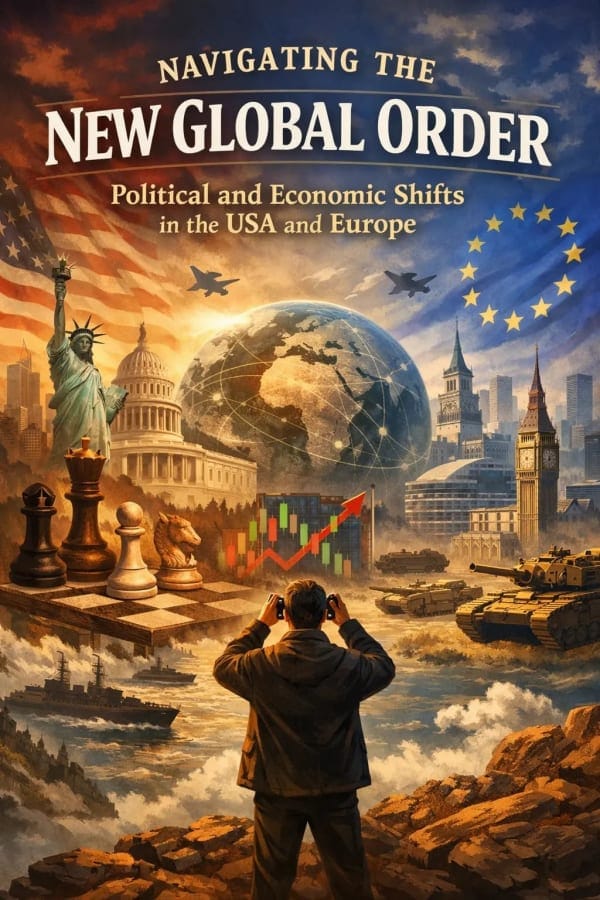
Navigating the New Global Order: Political and Economic Shifts in the USA and Europe
The geopolitical landscape is undergoing a massive transformation as the United States and Europe reassess their economic alliances, technological dependencies, and global strategies. As we move deeper into the decade, the traditional transatlantic partnership is evolving to meet the unprecedented challenges of a multipolar world.
In the United States, policymakers are increasingly focusing on domestic industrial resilience. Recent legislative pushes aim to secure supply chains, particularly in the semiconductor and artificial intelligence sectors, reducing reliance on overseas manufacturing. This "America First" approach to critical technology is reshaping global trade dynamics, prompting allies and competitors alike to adjust their economic postures. Furthermore, Washington's approach to global trade is becoming more transactional, prioritizing bilateral agreements that directly benefit the domestic workforce.
Across the Atlantic, Europe is aggressively pursuing "Strategic Autonomy." Driven by recent energy crises and the realization of their deep dependence on U.S. tech giants, the European Union is accelerating initiatives to build its own digital and energy infrastructure. From heavily investing in green technology to drafting the world's most comprehensive AI regulations, Brussels is determined to position Europe as an independent regulatory and economic superpower. This shift aims to protect European markets while maintaining a delicate balance between U.S. alliances and Asian trade dependencies.
Globally, these shifting priorities are creating a ripple effect. Emerging markets are navigating a complex web of new trade tariffs, technological embargoes, and shifting foreign direct investments. As the USA and Europe turn their focus inward to fortify their own economic foundations, the global economy is transitioning from an era of hyper-globalization to one of regionalized, strategic partnerships. The decisions made in Washington and Brussels today will undoubtedly set the rules of engagement for the global economy for decades to come.
In the United States, policymakers are increasingly focusing on domestic industrial resilience. Recent legislative pushes aim to secure supply chains, particularly in the semiconductor and artificial intelligence sectors, reducing reliance on overseas manufacturing. This "America First" approach to critical technology is reshaping global trade dynamics, prompting allies and competitors alike to adjust their economic postures. Furthermore, Washington's approach to global trade is becoming more transactional, prioritizing bilateral agreements that directly benefit the domestic workforce.
Across the Atlantic, Europe is aggressively pursuing "Strategic Autonomy." Driven by recent energy crises and the realization of their deep dependence on U.S. tech giants, the European Union is accelerating initiatives to build its own digital and energy infrastructure. From heavily investing in green technology to drafting the world's most comprehensive AI regulations, Brussels is determined to position Europe as an independent regulatory and economic superpower. This shift aims to protect European markets while maintaining a delicate balance between U.S. alliances and Asian trade dependencies.
Globally, these shifting priorities are creating a ripple effect. Emerging markets are navigating a complex web of new trade tariffs, technological embargoes, and shifting foreign direct investments. As the USA and Europe turn their focus inward to fortify their own economic foundations, the global economy is transitioning from an era of hyper-globalization to one of regionalized, strategic partnerships. The decisions made in Washington and Brussels today will undoubtedly set the rules of engagement for the global economy for decades to come.