
Click to enlarge
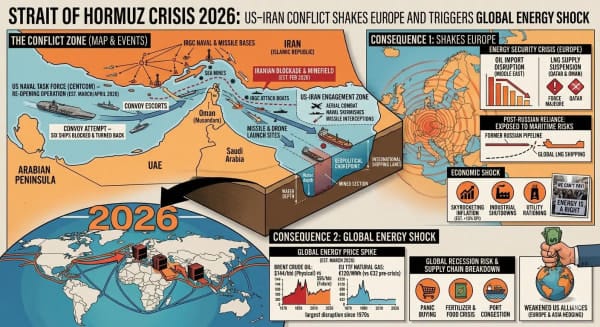
Strait of Hormuz Crisis 2026: US–Iran Conflict Shakes Europe and Triggers Global Energy Shock
The 2026 Strait of Hormuz crisis has rapidly evolved into the most critical geopolitical and economic flashpoint affecting the United States, Europe, and the global economy. What began as a regional conflict has now escalated into a multidimensional crisis involving military tensions, energy disruptions, and deep fractures within Western alliances.
Breaking: Strait of Hormuz Closure Threatens Global Oil Supply
Iran’s decision to repeatedly close the Strait of Hormuz, one of the world’s most strategic oil chokepoints, has sent shockwaves through global markets. Reports confirm Iranian forces have fired on commercial tankers, escalating fears of a prolonged disruption in energy supply chains.
Roughly 20% of global oil trade flows through this narrow passage, making any disruption immediately impactful on fuel prices, logistics, and inflation worldwide.
Global Economic Impact: IMF Warns of Recession Risk
At emergency-level discussions during international financial meetings, the International Monetary Fund (IMF) warned that the conflict is already slowing global growth and increasing inflation. Forecasts for 2026 have been downgraded, with the crisis described as the most severe energy shock since the 1970s.
Energy prices are rising sharply, hitting Europe particularly hard due to its dependence on imported energy, while developing economies face even greater vulnerability.
Europe Reacts: NATO Tensions and Strategic Uncertainty
The crisis is exposing deep divisions between the United States and European allies. Several NATO countries have refused to support US military actions, leading to tensions within the alliance.
At the same time, European leaders are actively preparing post-war military and logistical plans to secure shipping routes and stabilize the region.
Turkey has warned that any US withdrawal from European security structures could be “destructive”, highlighting growing uncertainty about NATO’s future and transatlantic cooperation.
Geopolitical Shift: A New Global Power Balance
Beyond the immediate crisis, analysts suggest the conflict is accelerating a broader global power realignment. The United States is leveraging its energy production capabilities, potentially strengthening its position as a dominant global supplier, while Europe and Asia are forced to reconsider long-term energy strategies.
Meanwhile, China and other global actors are increasingly involved in diplomatic and economic maneuvering, signaling the emergence of a more fragmented and competitive international order.
What Happens Next?
The situation remains highly volatile. While ceasefire talks have occurred intermittently, the continued naval blockade, military escalation, and tanker attacks suggest that a lasting resolution is far from guaranteed.
If tensions persist, the world could face:
* Sustained high energy prices
* Deepening economic slowdown
* Long-term restructuring of global alliances
Breaking: Strait of Hormuz Closure Threatens Global Oil Supply
Iran’s decision to repeatedly close the Strait of Hormuz, one of the world’s most strategic oil chokepoints, has sent shockwaves through global markets. Reports confirm Iranian forces have fired on commercial tankers, escalating fears of a prolonged disruption in energy supply chains.
Roughly 20% of global oil trade flows through this narrow passage, making any disruption immediately impactful on fuel prices, logistics, and inflation worldwide.
Global Economic Impact: IMF Warns of Recession Risk
At emergency-level discussions during international financial meetings, the International Monetary Fund (IMF) warned that the conflict is already slowing global growth and increasing inflation. Forecasts for 2026 have been downgraded, with the crisis described as the most severe energy shock since the 1970s.
Energy prices are rising sharply, hitting Europe particularly hard due to its dependence on imported energy, while developing economies face even greater vulnerability.
Europe Reacts: NATO Tensions and Strategic Uncertainty
The crisis is exposing deep divisions between the United States and European allies. Several NATO countries have refused to support US military actions, leading to tensions within the alliance.
At the same time, European leaders are actively preparing post-war military and logistical plans to secure shipping routes and stabilize the region.
Turkey has warned that any US withdrawal from European security structures could be “destructive”, highlighting growing uncertainty about NATO’s future and transatlantic cooperation.
Geopolitical Shift: A New Global Power Balance
Beyond the immediate crisis, analysts suggest the conflict is accelerating a broader global power realignment. The United States is leveraging its energy production capabilities, potentially strengthening its position as a dominant global supplier, while Europe and Asia are forced to reconsider long-term energy strategies.
Meanwhile, China and other global actors are increasingly involved in diplomatic and economic maneuvering, signaling the emergence of a more fragmented and competitive international order.
What Happens Next?
The situation remains highly volatile. While ceasefire talks have occurred intermittently, the continued naval blockade, military escalation, and tanker attacks suggest that a lasting resolution is far from guaranteed.
If tensions persist, the world could face:
* Sustained high energy prices
* Deepening economic slowdown
* Long-term restructuring of global alliances